A Rational Approach to Baccarat for More Stable Results
Baccarat is often perceived as a game of momentum—where streaks are chased and patterns are trusted. Yet beneath the surface, baccarat remains a structured probability system with fixed rules and a defined house edge. Players seeking stable results must shift from emotional reaction to rational decision-making.
A rational baccarat strategy does not attempt to defeat probability. Instead, it works within it. Stability in baccarat comes from disciplined bankroll management, consistent bet sizing, controlled tempo, and emotional neutrality. When approached logically, baccarat becomes less about prediction and more about risk regulation.
Understanding this perspective transforms the session experience. The objective is not dramatic short-term wins, but controlled and sustainable engagement slot gacor.
Understanding the Mathematical Foundation
Baccarat offers three primary betting options: Banker, Player, and Tie. Statistically, the Banker bet carries the lowest house edge (after commission), followed closely by Player. Tie holds significantly higher volatility and house advantage.
In global casino centers such as Macau and Las Vegas, experienced players often prioritize Banker or Player consistently rather than switching impulsively. This approach reflects an understanding of long-term probability.
A rational baccarat strategy begins with accepting two truths:
- Each hand is statistically independent.
- The house maintains a slight mathematical advantage over time.
Once these principles are accepted, decision-making becomes clearer and less reactive.
Bankroll Structure as the Core of Stability
Stability in baccarat does not come from predicting outcomes—it comes from managing exposure.
A structured bankroll system includes:
- Defining a fixed session budget
- Dividing bankroll into small betting units (1–2% per wager)
- Setting a clear stop-loss limit
- Establishing a realistic profit target
Without structure, even short streaks can create emotional volatility. With structure, variance becomes manageable.
For example, if a player allocates 100 units for a session and risks only 1 unit per round, a five-hand losing streak represents just 5% of total capital. This reduces psychological pressure and preserves rational thinking.
Avoiding Emotional Escalation
One of the most common mistakes in baccarat is progressive escalation driven by emotion. Doubling bets after losses or dramatically increasing wagers during streaks exposes bankroll to unnecessary volatility.
A rational baccarat strategy avoids:
- Impulsive bet doubling
- Large shifts in wager size mid-session
- Attempting to “recover quickly” after losses
- Overconfidence during winning runs
Consistency is more powerful than aggression. Rational players treat each hand as part of a long session rather than a defining moment.
Pattern Observation Without Overcommitment
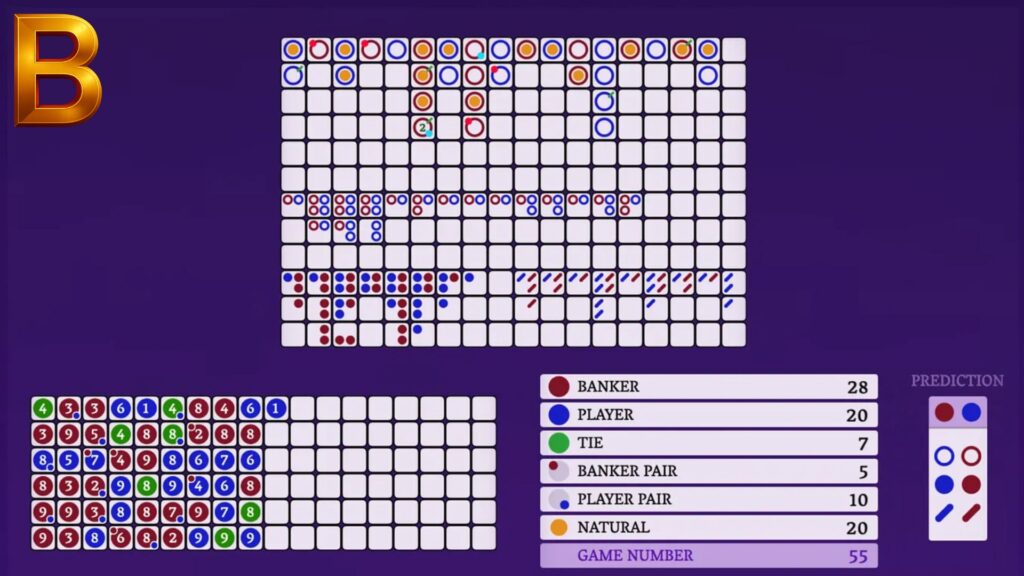
Scoreboards and roadmaps display previous Banker and Player results. While these tools help track session flow, they should not be treated as predictive systems.
Streaks and alternating patterns are natural outcomes of random distribution. Rational players use these charts for organization—not certainty.
A balanced approach includes:
- Observing patterns without assuming continuation
- Avoiding heavy exposure on short streaks
- Recognizing that reversals are inevitable
The goal is not to chase momentum but to maintain structured play.
Tempo Management in Modern Sessions
Modern baccarat—particularly live-streamed platforms—operates at high speed. Rapid dealing can encourage impulsive reactions.
To maintain rational control:
- Pause briefly between bets
- Skip rounds when uncertain
- Step away if emotional intensity rises
Slowing internal tempo stabilizes external decisions. Rational baccarat strategy depends on measured pacing.
Choosing the Lower Edge Path
While no option eliminates house edge, choosing bets with lower disadvantage improves long-term stability.
- Banker: Lowest house edge (after commission)
- Player: Slightly higher but stable
- Tie: High volatility and higher house advantage
A rational approach typically minimizes Tie exposure due to its disproportionate risk relative to payout.
Over extended sessions, small edge differences accumulate. Stability improves when mathematical disadvantage is minimized.
Defining Clear Session Endpoints
Stability requires knowing when to stop.
Two critical boundaries:
- Stop-Loss Limit – Protects against uncontrolled drawdowns.
- Profit Target – Locks in gains before variance reverses.
Rational players honor these limits without exception. Emotional players override them.
Ending sessions at predefined thresholds protects long-term sustainability.
Long-Term Perspective Over Short-Term Emotion
Short sessions may produce dramatic results—both positive and negative. However, rational baccarat strategy focuses on sustainability across many sessions.
By maintaining:
- Consistent bet sizing
- Disciplined bankroll allocation
- Controlled tempo
- Emotional neutrality
Players reduce volatility and increase session stability.
While baccarat remains a negative expectation game over infinite play, structured discipline can produce smoother variance within finite sessions.
The Role of Self-Control
Ultimately, rational play is less about the cards and more about behavior. The strongest edge available to a player is self-regulation.
Stable results emerge when:
- Decisions are pre-planned
- Risk exposure is limited
- Emotional reactions are minimized
- Discipline overrides impulse
Rational thinking transforms baccarat from a reactive gamble into a controlled probability exercise.
Conclusion
A rational approach to baccarat for more stable results emphasizes mathematics, discipline, and emotional control. By understanding probability foundations, structuring bankroll responsibly, minimizing exposure to high-edge bets, and maintaining consistent wager sizing, players can reduce volatility.
In international casino environments and modern live-streamed platforms alike, the principle remains constant: stability comes from structure, not prediction.
Rational baccarat strategy does not promise guaranteed profit. Instead, it offers something more valuable—measured risk, emotional balance, and controlled session management.
Cek Juga Artikel Gacor Dari Platform : globenews24